
Doors
New doors, without new doors.
Guest-room, corridor, office and cabin doors refinished in place — slab, frame and jamb — without pulling a single door off its hinges in most cases.
What it is
Door Refinishing & Wrapping
Replacing doors in an occupied building is a scheduling problem more than a carpentry one: lead times, hardware transfers, fire ratings to re-certify, and a hole in the wall in the meantime. Film changes the face of the door where it hangs. Hardware stays, the fire label stays, the opening stays secure.
Send a photo and rough dimensions if you have them — we'll tell you what's possible.
Or text (561) 223-1826
Text us a photo of your doors
Send a photo and rough dimensions if you have them — we'll tell you what's possible.

Scan to text us from your phone
What we resurface
- Door slabs, both faces
- Frames, jambs and stops
- Hardware surrounds and edge returns
- Closet, bi-fold and pocket doors
- Cabin and joinery doors on yachts
Why it works here
The label stays on the door
Because the door assembly isn't replaced, its existing fire label and hardware stay exactly as they are. Nothing is re-hung or re-cored.
Corridor by corridor
Hotels and multifamily buildings are done in sections so guests and residents keep using the floor while it changes.
Consistent across hundreds of openings
One roll covers many doors, so the finish is identical from the first opening to the last — something a field-applied stain rarely achieves.
Our work
Yacht cabin doors
Cabin and joinery doors on a 40' motor yacht, refinished aboard in an Altyno grey oak woodgrain alongside the bulkheads and stair treads.
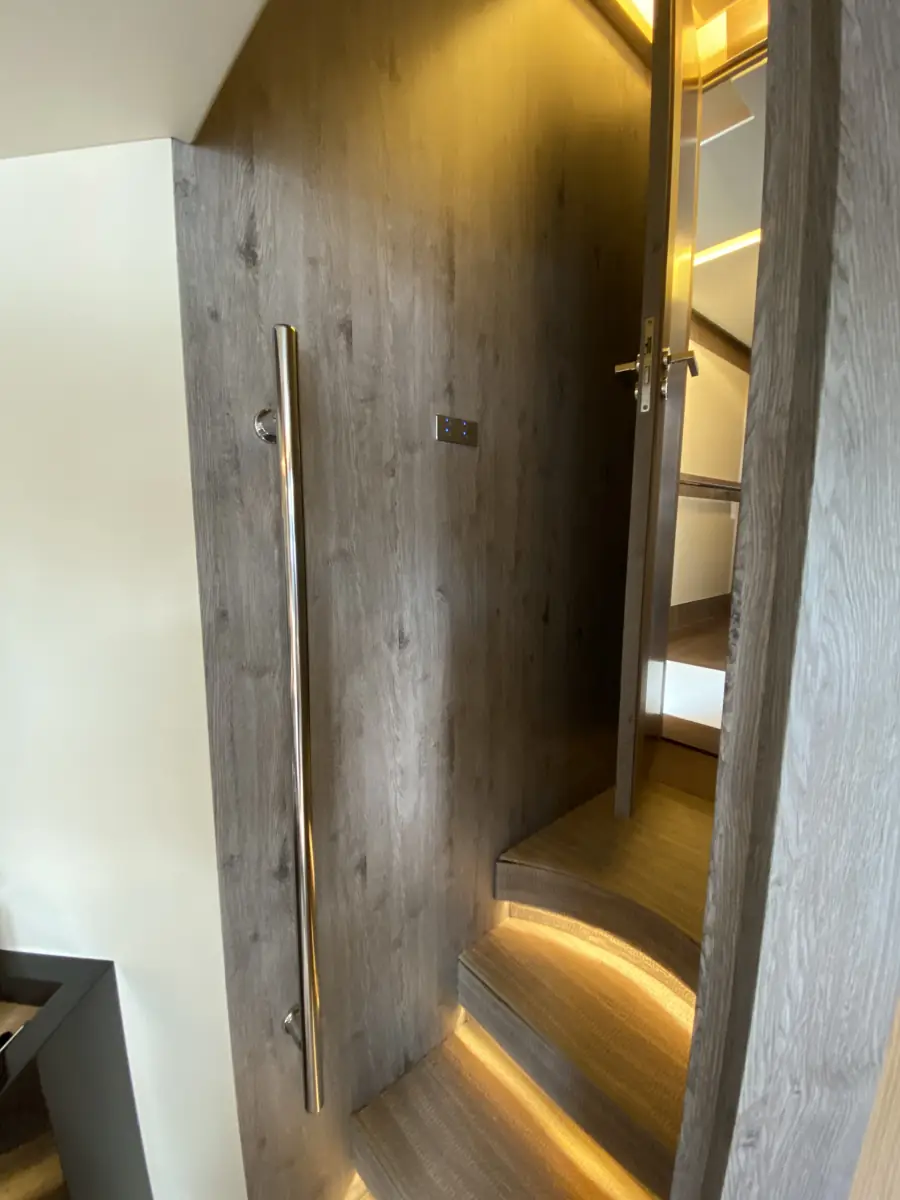
A real Vantage Surface installation. See more of our work →
Finishes
Over 460 finishes to choose from.
Woodgrains, stone and marble, metals, solids, textiles and specialty films — see any of them on a photo of your own space, or have physical samples mailed to you.
Resurface vs. Replace
Keep the structure. Change the finish.
Replacement removes what's already there and rebuilds it. Resurfacing works with the surface you have. Where the existing substrate is sound, that difference in scope is what keeps a space open while it changes.
Architectural Resurfacing
- Installed over the surface you already have
- Little to no demolition dust or debris
- Nights, weekends, or phased around your hours
- Built for occupied buildings
- No tear-out, disposal, or new substrate
Traditional Replacement
- Existing surface removed and rebuilt
- Dumpsters, dust, and debris
- Typically continuous daytime work
- Usually needs the space closed or emptied
- Demolition, disposal, and material lead times
Describes typical differences in scope, not guaranteed outcomes. Suitability depends on the condition of the existing surface — every project is assessed and quoted individually.
FAQ
Questions, answered.
Do the doors come off?
Usually not. Most doors are wrapped in place. Occasionally a door is taken down to reach an edge cleanly, then re-hung the same day.
What about the fire rating?
A rated door keeps its rating because the assembly isn't altered. Where a specification calls for a rated surface finish as well, we'll supply the film's test data before ordering.
Can you match existing doors we're keeping?
Send a photo and, if you can, a small sample or the original product name. We'll pull the closest matches and mail you physical swatches to hold against the door.
How many doors is worth doing?
There's no minimum in principle, but film comes on rolls — larger runs get much better material efficiency. A single door is usually done as part of other work in the same space.
Also